Achilles tendinitis is one of the most common — and commonly underestimated — causes of persistent heel and lower leg pain. Many patients try rest, ice, stretching, and physical therapy, only to find that symptoms return the moment activity resumes. For those stuck in this cycle, shockwave therapy offers a clinically supported path forward.
At the Foot & Ankle Center of Arizona, our board-certified podiatrists and fellowship-trained foot and ankle surgeons use extracorporeal shockwave therapy (ESWT) as a targeted, non-surgical intervention for patients who haven’t responded to conventional care.
Why Achilles Tendinitis Becomes Chronic — and Why That Changes Treatment
Achilles tendinopathy exists on a spectrum. In its early stages, the tendon responds predictably to conservative care: load reduction, eccentric strengthening, and time. But when symptoms persist beyond 3 to 6 months, underlying tissue changes occur. The chronic phase is characterized by collagen disorganization, neovascularization, and a shift away from the acute inflammatory response that normally drives healing. In short, the body stops trying to fix itself.
This is the critical distinction. Chronic Achilles tendinopathy isn’t an inflammation problem — it’s a failed healing problem. Treatments that work well acutely often fall flat at this stage because the underlying biology is different.
What is Shockwave Therapy?
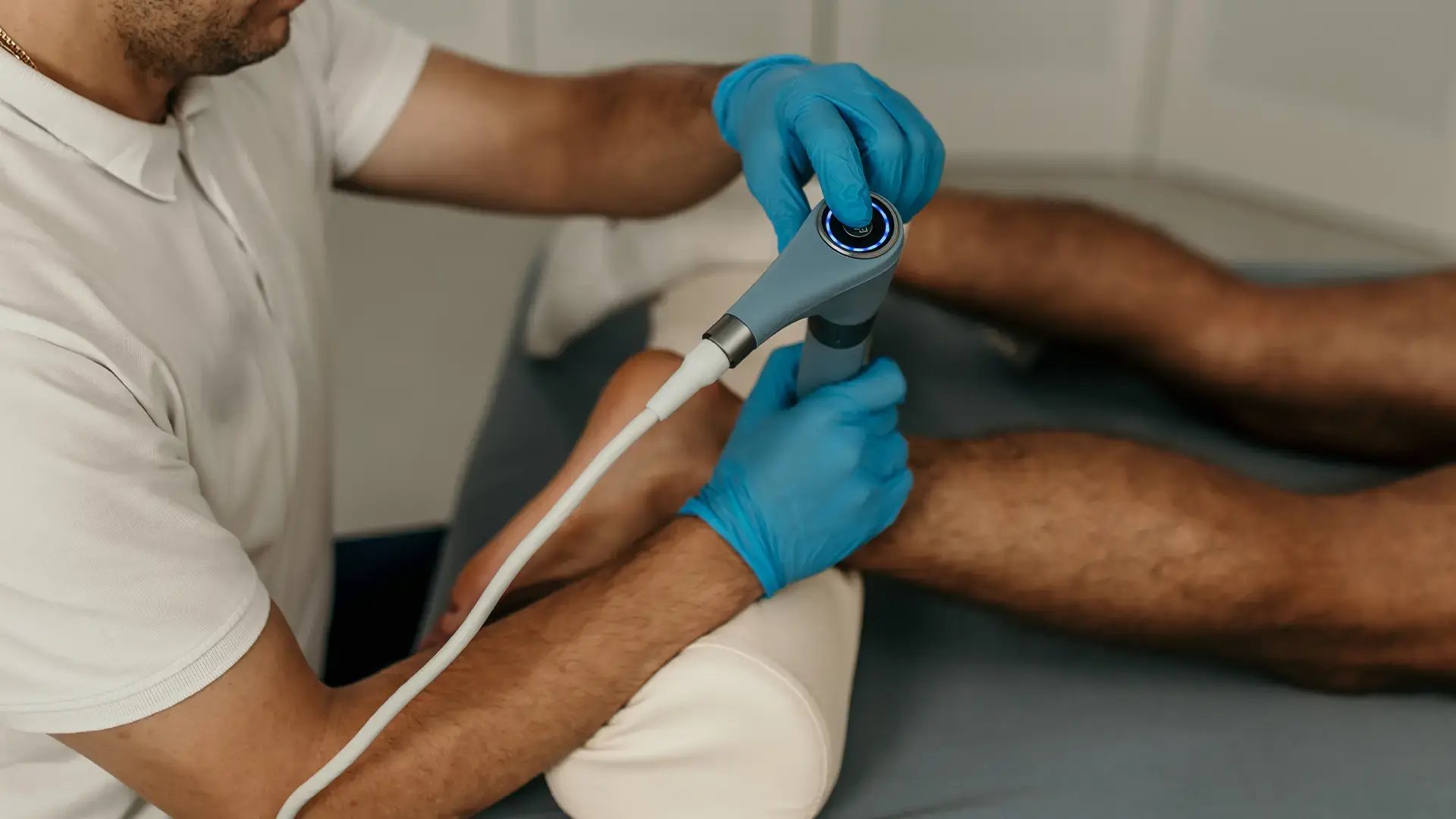
ESWT delivers focused acoustic energy waves to targeted tissue through the skin — no incisions, no needles, no downtime. Initially developed for breaking up kidney stones, this technology was later adapted for musculoskeletal applications after clinicians observed its regenerative effects on tendons and bone.
Key characteristics of shockwave therapy include:
- Non-invasive and performed in-office, typically in under 20 minutes
- No anesthesia required
- No surgical recovery period
- Cleared by the FDA for specific musculoskeletal indications
- Supported by a growing body of peer-reviewed clinical evidence for Achilles tendinopathy
How Shockwave Therapy Works on Achilles Tendon Tissue
Acoustic waves delivered during ESWT interact with tendon tissue at the cellular level. Rather than masking pain, the treatment is intended to stimulate the biological mechanisms that chronic tendons have lost access to.
Clinically observed effects include:
- Stimulation of collagen synthesis: Promoting the production of organized Type I collagen to restore structural integrity to degenerative tendon tissue
- Neovascularization: Encouraging new blood vessel formation to improve oxygen and nutrient delivery to the tendon
- Disruption of pathological calcifications: Breaking down calcium deposits that can form in chronic insertional Achilles tendinitis
- Pain modulation: Reducing local nerve fiber activity to decrease pain signaling in the treated area.
Who Is a Good Candidate for Shockwave Therapy for Achilles Tendinitis?
Shockwave therapy is most appropriate when conservative measures have been given adequate time and have not produced sufficient relief. More specifically, patients who tend to respond well typically present with:
- Chronic mid-portion or insertional Achilles tendinopathy persisting beyond three months
- Incomplete response to physical therapy, eccentric loading protocols, or orthotics
- Imaging findings consistent with tendinopathy or calcific deposits
- A preference to avoid surgical intervention when clinically appropriate
Conversely, shockwave therapy is generally not recommended for patients with active infections, clotting disorders, open wounds near the treatment site, or during pregnancy. Your provider will review your complete history before recommending this or any treatment.
What Patients Get Wrong About Regenerative Therapy and Achilles Recovery
One of the most common misconceptions is that shockwave therapy provides instant results. It does not — and that’s not a flaw in the treatment. Because ESWT initiates biological repair processes, meaningful clinical improvements often emerge over weeks to months as tissue remodels. Patients who expect to feel dramatically better after a single session are frequently disappointed, while those who understand the timeline tend to follow through and achieve better outcomes.
It’s also worth noting that some discomfort during and immediately after treatment is normal. The sensation reflects the acoustic energy interacting with sensitive tendon tissue. Post-treatment soreness typically resolves within 24 to 48 hours and is not an indicator of treatment failure.
Frequently Asked Questions About Shockwave Therapy for Achilles Tendinitis in Arizona
How Many Shockwave Therapy Sessions Does it Take to Treat Achilles Tendinitis?
Most patients undergo three to five sessions, spaced one week apart. The exact number depends on the severity of tendon involvement, the presence of calcifications, and how the tissue responds over time. Your provider will evaluate your progress at each visit and adjust the treatment plan accordingly.
Is Shockwave Therapy Painful for Achilles Tendinitis?
Patients commonly describe the sensation as a deep, rhythmic pressure — tolerable but noticeable, particularly at the most affected area of the tendon. Treatment intensity can be adjusted for patient comfort. Post-treatment soreness may persist for a day or two, after which most patients can resume normal low-impact activity.
Ready to Move Past Chronic Achilles Pain? Arizona's Foot Specialists Are Ready to Help
Chronic Achilles pain does not have to be your baseline. The Foot & Ankle Center of Arizona provides evidence-based, individualized care for the full spectrum of foot and ankle conditions — from conservative management to complex reconstructive surgery. If you’ve been managing tendon pain without lasting improvement, a comprehensive evaluation is the right next step. Our board-certified podiatrists and fellowship-trained foot and ankle surgeons serve patients across North Scottsdale, Gilbert, and Peoria.
Contact the Foot and Ankle Center of Arizona today to schedule your consultation.
 June 26, 2026
-optimized.webp)